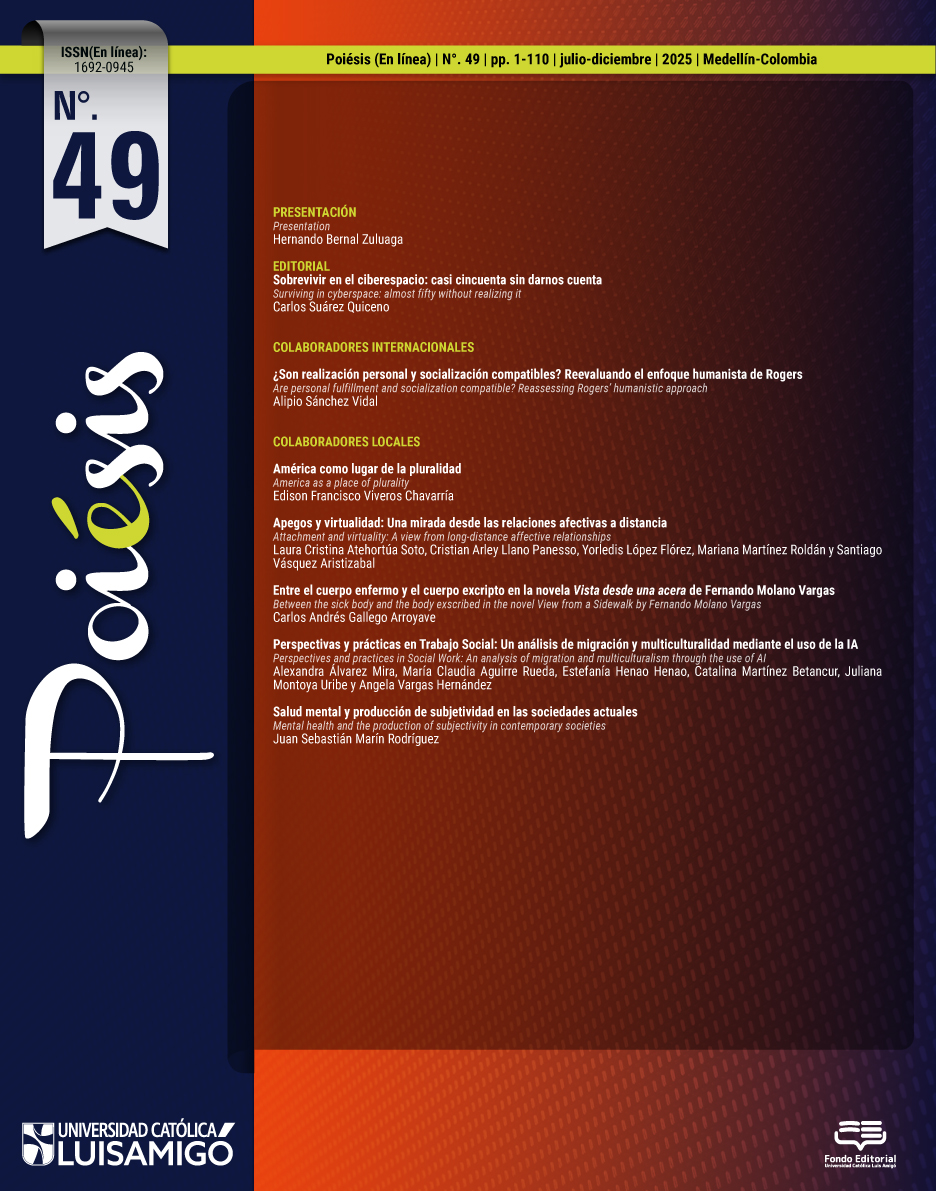
Are self-realization and socialization compatible? Reevaluating Rogers humanistic approach
DOI:
https://doi.org/10.21501/16920945.4699Keywords:
Carl Rogers, Community, Human development, Humanism, Critical thinking, SocializationAbstract
The aim of this paper is to reevaluate Rogers’ humanistic approach from the perspective of human development in view of Vázquez Arellano & García Rodríguez (2021) critical analysis which is examined firstly rejecting several of its objections for absurd or arbitrary, and agreeing with others, although no with its tone and wording. I evaluate afterwards the critical approaches from a cognitive, practical-evaluative, and attitudinal perspective concluding that although non dogmatic criticism is desirable in intellectual analysis and life, taken to the limit becomes a destructive and discouraging devise due to its negativism, lack of modulation, and aversion to action and empirical testing. It is then identified individualism, elitism, and naivety as shortcomings of Rogerian approach posing alternatives which complement it by adding confrontation and empowerment strategies to those of cooperation and empathy, and exogenous models of human development which underlie social interactions, roles, and supplies. I finally question Rogerian unconditional acceptance showing the tension between that mandate and responsible socialization which requires conditioning approval, love and other social rewards to the interests and objectives of the community.
Downloads
References
Alinsky, S. (2012). Tratado para radicales. Traficantes de Sueños.
Bugental, J. (1964). The third force in psychology [La tercera fuerza en psicología]. Journal of Humanistic Psychology, 1, 19-26. https://doi.org/10.1177/002216786400400102
Caplan, G. (1979). Principios de psiquiatría preventiva. Paidós.
Deci, E. L., & Ryan R. M. (Eds.). (2002). Handbook of self-determination research [Manual de investigación sobre la autodeterminación]. University of Rochester Press.
Dewey, J. (1944). Democracy and education [Democracia y educación]. The Free Press.
Doyal, L., & Gough, I. (1991). A theory of human need [Una teoría de la necesidad humana]. McMillan.
Fromm, E. (1955). The sane society [La sociedad sana]. Fawcett.
Fromm, E. (1966). El miedo a la libertad. Paidós.
Gottlieb, A. (1987). Do you believe in magic? Bringing the 60s back home [¿Crees en la magia? Trayendo los 60’s de Nuevo a casa]. Fireside.
Habermas J. (1984). Conocimiento e interés. En J. Habermas, Ciencia y técnica como “ideología” (pp. 159-181). Tecnos.
Hall, C. S., & Lindzey, G. (1978). Theories of personality [Teorías de la personalidad]. Wiley.
Leahey, T. (2005). Historia de la Psicología. Pearson Educación.
Lebret, L. J. (1966). Dinámica concreta del desarrollo. Herder.
Lugo, J. O., & Hershey, G. (1979). Human development. A psychological, biological and sociological approach to the life span [Desarrollo humano. Un enfoque psicológico, biológico y sociológico de la duración de la vida]. MacMillan.
Maslow, A. H. (1975). Motivación y personalidad. Sagitario.
Max-Neef, M. A. (1993). Desarrollo a escala humana. Nordan-Icaria.
Meador, B., & Rogers, C. (1978). Person-centered therapy [Psicoterapia centrada en el cliente]. En R. J. Corsini (Ed.), Current psychotherapies (pp. 131-184). Peakock.
Merton, R. K. (2002). Teoría y estructura sociales. Fondo de Cultura Económica.
Parker, I. (2010). La psicología como ideología. Contra la disciplina. Libros de la Catarata.
Quitmann, H. (1989). Psicología Humanística. Herder.
Rogers, C. (1961). On becoming a person [Convertirse en persona]. Houghton Mifflin.
Royce, J., & Mos, P. (1981). Humanistic Psychology. Concepts and criticism [Psicología humanista. Conceptos y críticas]. Plenum.
Salkind, N. (1985). Theories of human development [Teorías del desarrollo humano]. Wiley.
Sánchez Vidal, A. (2007). Manual de Psicología Comunitaria. Pirámide.
Sánchez Vidal, A. (2016). Él hombre en busca del límite. Realización personal y desarrollo humano [Manuscrito inédito].
Sánchez Vidal, A. (2017). Empoderamiento, liberación y desarrollo humano. Psychosocial Intervention, 26(3), 155-163. https://dx.doi.org/10.1016/j.psi.2017.05.001
Schultz, D. (1977). Growth psychology: Models of the healthy personality [Psicología del crecimiento: Modelos de la personalidad sana]. Van Nostrand Reinhold.
Schneider, K., Bugental, J., & Pierson, J. (2001). The handbook of Humanistic Psychology [El manual de la psicología humanista]. Sage.
Sen, A. (1990). Development as capability expansion [Desarrollo como capacidad de expansión]. En K. Griffin & J. Knight (Eds.), Human development and the international development strategy for the 1990s (pp. 41-59). Palgrave Macmillan London.
Smith M. B. (1991). Values, self, and society. Toward a humanistic social psychology [Valores, sí mismo y sociedad. Hacia una psicología humanista social]. Transaction Publishers.
Strupp H. H., & Hadley, S. W. (1977). A tripartite model of mental health and therapeutic outcomes: with special reference to negative effects in psychotherapy [Un modelo tripartite de la salud mental y resultados terapéuticos: con especial referencia a efectos negativos en la psicoterapia]. American Psychologist, 32(3), 187-196. https://doi.org/10.1037/0003-066X.32.3.187
Vázquez Arellano, A., & García Rodríguez, R. E. (2021). La vocación no directiva de Carl Rogers: teoría psicoterapia y relaciones de poder. Revista Crítica de Ciências Sociais, (125), 77-98 . https://doi.org/10.4000/rccs.12053
Villegas i Besora, M. (1986). La Psicología Humanista: Historia, concepto y método. Anuario de Psicología, (34), 7-46.
Watson, P. (2002). Historia intelectual del siglo XX. Crítica.
Weber, M. (1993). Economía y sociedad. Fondo de Cultura Económica.
Downloads
Published
How to Cite
Issue
Section
License

This work is licensed under a Creative Commons Attribution-NonCommercial-NoDerivatives 4.0 International License.
La revista y los textos individuales que en esta se divulgan están protegidos por las leyes de copyright y por los términos y condiciones de la Licencia Creative Commons Atribución-No Comercial- 4.0 Internacional. Permisos que vayan más allá de lo cubierto por esta licencia pueden encontrarse en http://www.funlam.edu.co/modules/fondoeditorial/ Derechos de autor.